


Costs of In-House Assembly
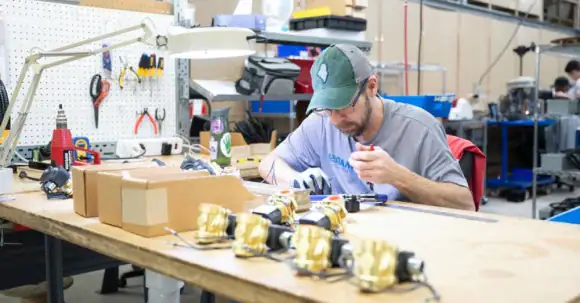
Equipment and labor both contribute to the overall costs of maintaining in-house electronics assembly. Organizations must account for facilities, specialized equipment, training, and the high opportunity cost of tying up capital in machinery.
-

Labor Requirements
Labor Requirements
Managing in-house production comes with a number of labor costs and responsibilities. These can include the following:
- Management overhead. Production requires dedicated supervision separate from engineering.
- Variable demand costs. Overtime premiums increase unit costs during surges, while idle labor drains the budget during lulls.
- Turnover & training. The cost of replacing and retraining skilled staff is a recurring expense.
-
Equipment Investment
Equipment Investment
With in-house electronics assembly, you’ll want to consider the initial investment and ongoing upkeep. A single selective soldering machine can cost over $150,000, before factoring in maintenance and setup. Upgrades and expansions can further add to this investment.
-
Training and Certification
Training and Certification
Quality standards are non-negotiable. For instance, achieving compliance with IPC-A-610 (acceptability of electronic assemblies) or WHMA/IPC-A-620 (wire harness usage) requires ongoing investment.
Training costs can accumulate through:
- Initial certification. Classroom instruction and hands-on skills verification.
- Recertification cycles. Standards are updated regularly, requiring periodic retraining.
- Audit & documentation. A Quality Management System (QMS) must track every employee’s competency records.





Benefits of Outsourced Assembly
Partnering with a contract manufacturer (CM) converts unpredictable capital expenses (CapEx) into manageable operational expenses (OpEx). This model leverages economies of scale that may be difficult for OEMs to achieve alone.
-
Cost Predictability
Cost Predictability
Outsourcing electronics assembly can address a number of cost risks and considerations, allowing for greater flexibility in cost and labor allocation. Additionally, a CM brings purchasing leverage to the table.
At MarVac Assemblies, we aggregate spend across hundreds of programs. This allows us to maintain:
- Stabilized labor rates. No overtime premiums or benefits administration headaches.
- Shared capital assets. Access to state-of-the-art AOI and soldering tech without ownership costs.
- Built-in compliance. IPC, ISO 9001:2015, and UL certifications are maintained as part of our service.
Instead of worrying about machine repairs or overtime pay, you only have one fixed unit price. This predictability can be invaluable for margin planning and financial forecasting.
-
Faster Scalability
Faster Scalability
Market demand can change quickly in the electronics industry, and new product launches or seasonal spikes can potentially strain internal resources. Outsourcing offers:
- Instant elasticity. Scale production up or down without hiring or firing staff.
- Rapid launch. Enjoy a faster time-to-market instead of waiting 6-12 months for new equipment to be delivered and installed.
- Flexible expansion. Test new markets with scalable capacity.
-
Reduced Supply Chain Risk
Reduced Supply Chain Risk
Managing hundreds of SKUs, tracking component quality, and maintaining documentation can create holes or risks in your supply chain. MarVac Assemblies consolidate this risk. We maintain safety stock, manage procurement for aging components, and utilize authorized distribution channels to prevent counterfeit parts from entering the supply chain. This integrated approach, combining distribution with assembly, helps eliminate the handoff friction between purchasing and production.





When Outsourcing Is the Better Choice
While some high-volume, low-mix products may suit in-house production, specific scenarios strongly favor the outsourcing model.

High Variability: If your demand fluctuates, in-house manufacturing can lead to potential risk or delays. Outsourcing aligns your spend with your revenue. In other words, you only pay for what you need, when it’s needed.

Limited Floor Space: Dedicating square footage to assembly, inventory storage, and shipping docks diverts resources from higher-value activities like R&D or customer showrooms. Repurposing that space often yields a higher ROI than assembling products internally.

Need for Certified Processes: If you are entering highly-regulated markets like medical or military, the cost of building a compliant QMS from scratch can be higher or require specialized expertise. By partnering with us, you inherit the benefits of our ISO 9001:2015 and IPC-A-620 certified processes. Maintaining relationships with highly qualified partners also means building in support and services backed by industry experience.

Choose MarVac Assemblies As Your Electronics Assembly Partner
The choice between outsourced electronics assembly vs. in-house production ultimately defines your operational agility. In-house production may suit certain stable, ultra-high-volume products, but outsourcing with the right partner can support production flexibility, risk reduction, and cost efficiency. Since 1995, MarVac Assemblies has worked with OEMs to deliver integrated supply chain and manufacturing solutions. Whether you need wire harness fabrication, box builds, or electromechanical assembly, we scale with your business so you can focus on innovation, not infrastructure.
Evaluating your production strategy? Request information today to discuss your specific requirements. We will analyze your volume and BOM to determine if contract manufacturing is the right move for your bottom line.